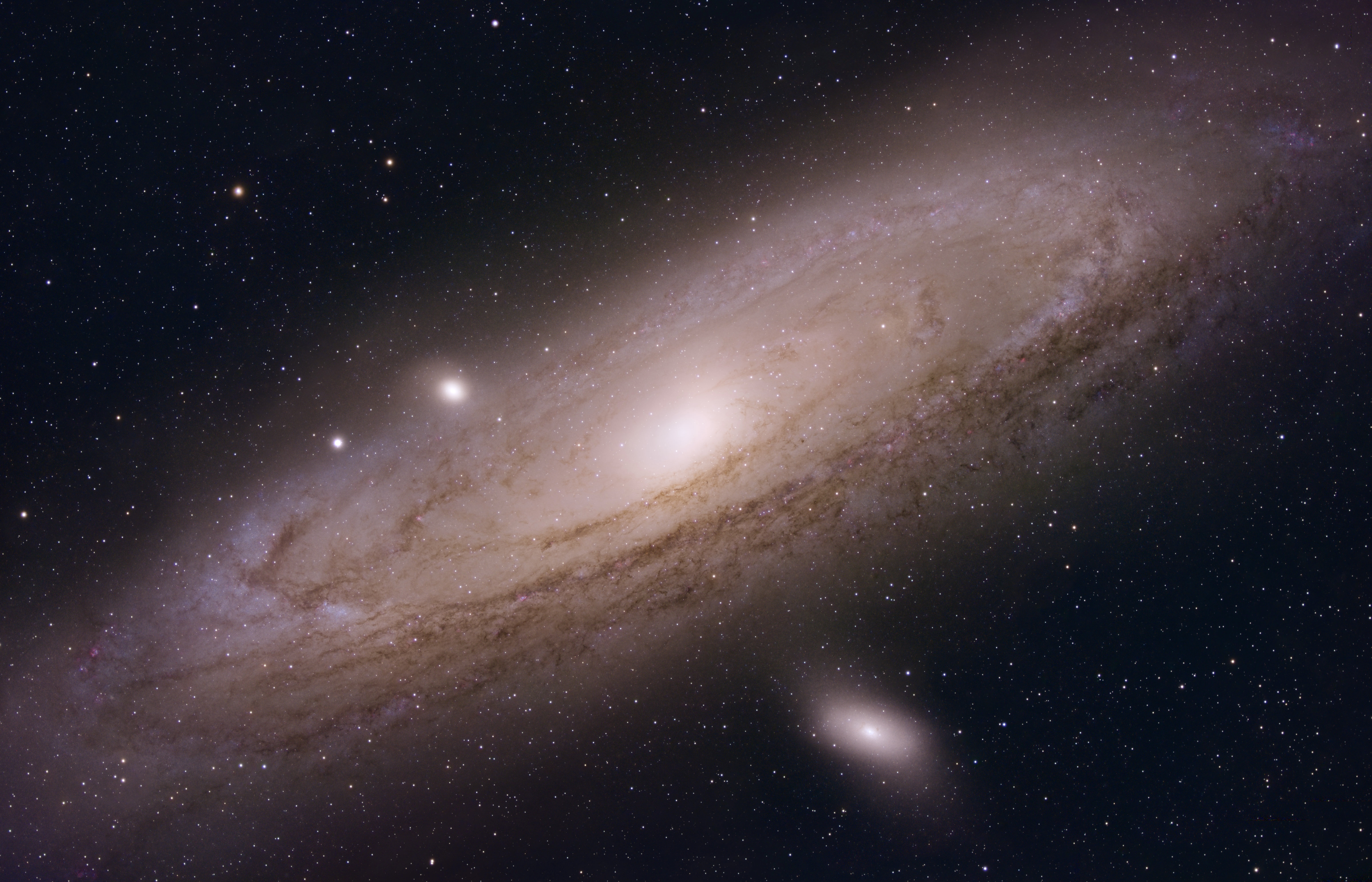
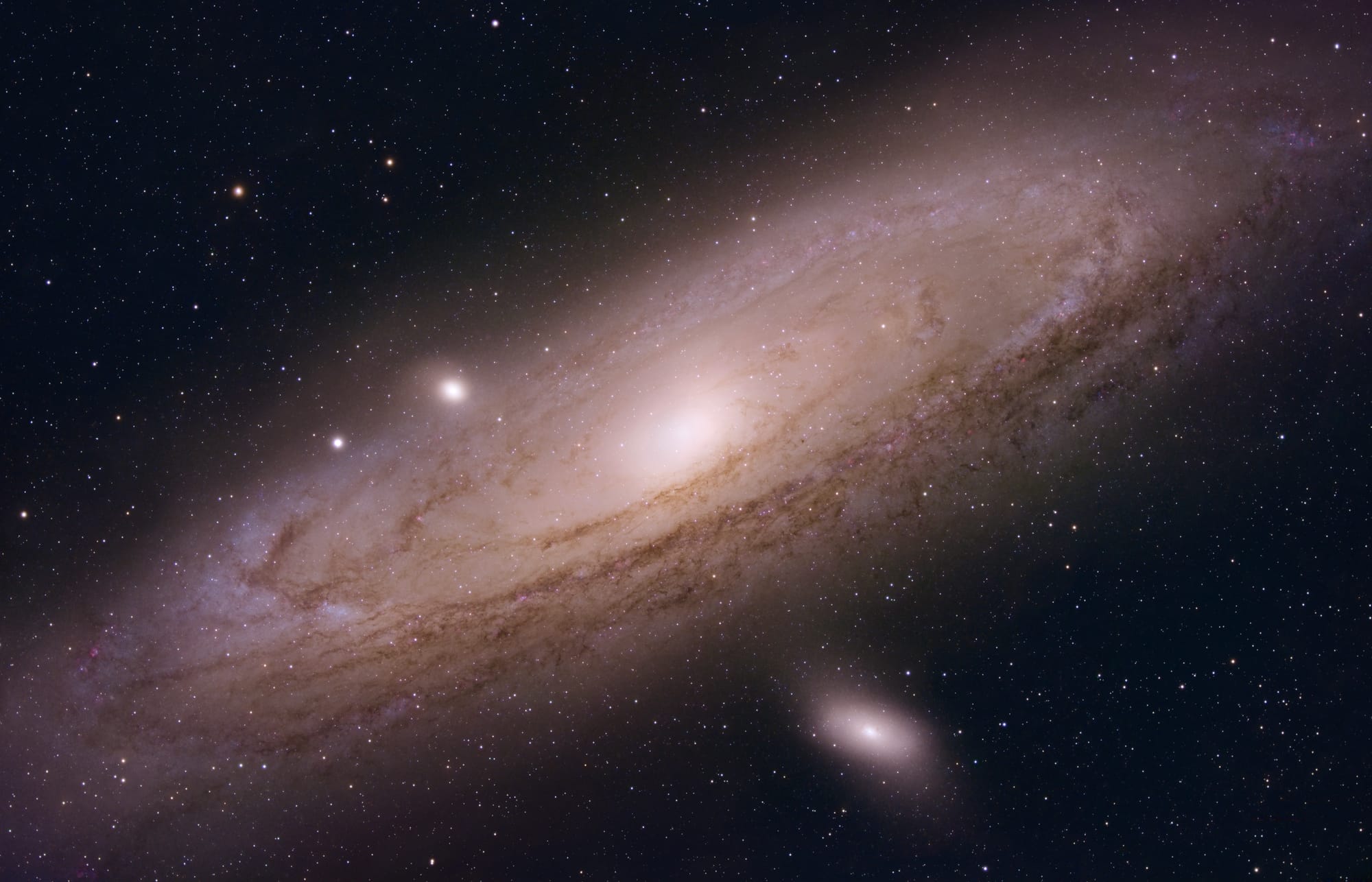
Andromeda (M31) is the nearest large galaxy to us and the grand sibling of the Milky Way.
It was this very galaxy that Edwin Hubble examined in 1923, when he spotted a variable star against its dense sea of light. That tiny handwritten VAR! on the photographic plate changed humanity’s understanding of the Universe forever — M31 turned out not to be a nebula within our own Galaxy, but an entire separate world, two and a half million light-years away.
Today, the same galaxy can be photographed by an ordinary amateur astronomer — with a staggering amount of detail. In this image you can see dust lanes, hydrogen clouds, and blue reflection nebulae: whole archipelagos of star formation. Every pixel hides the light of thousands of suns, and Andromeda itself contains roughly a trillion stars.
And looking at this ancient glow, it’s hard not to wonder: somewhere among those stars, perhaps someone is photographing their own night sky — and sees us as a tiny galaxy on the distant edge of the cosmos.
| Camera | ZWO ASI2600MC |
| Optics | Askar 103 APO |
| Mount | UMi 17S |
| Gain | 100 |
| Sensor Temperature | –10 °C |
| F-ratio | f/5.6 |
| Exposure | 83 × 300 s |
| Total Integration | 6.9 h |
| Processing | Siril, GraXpert, Affinity |