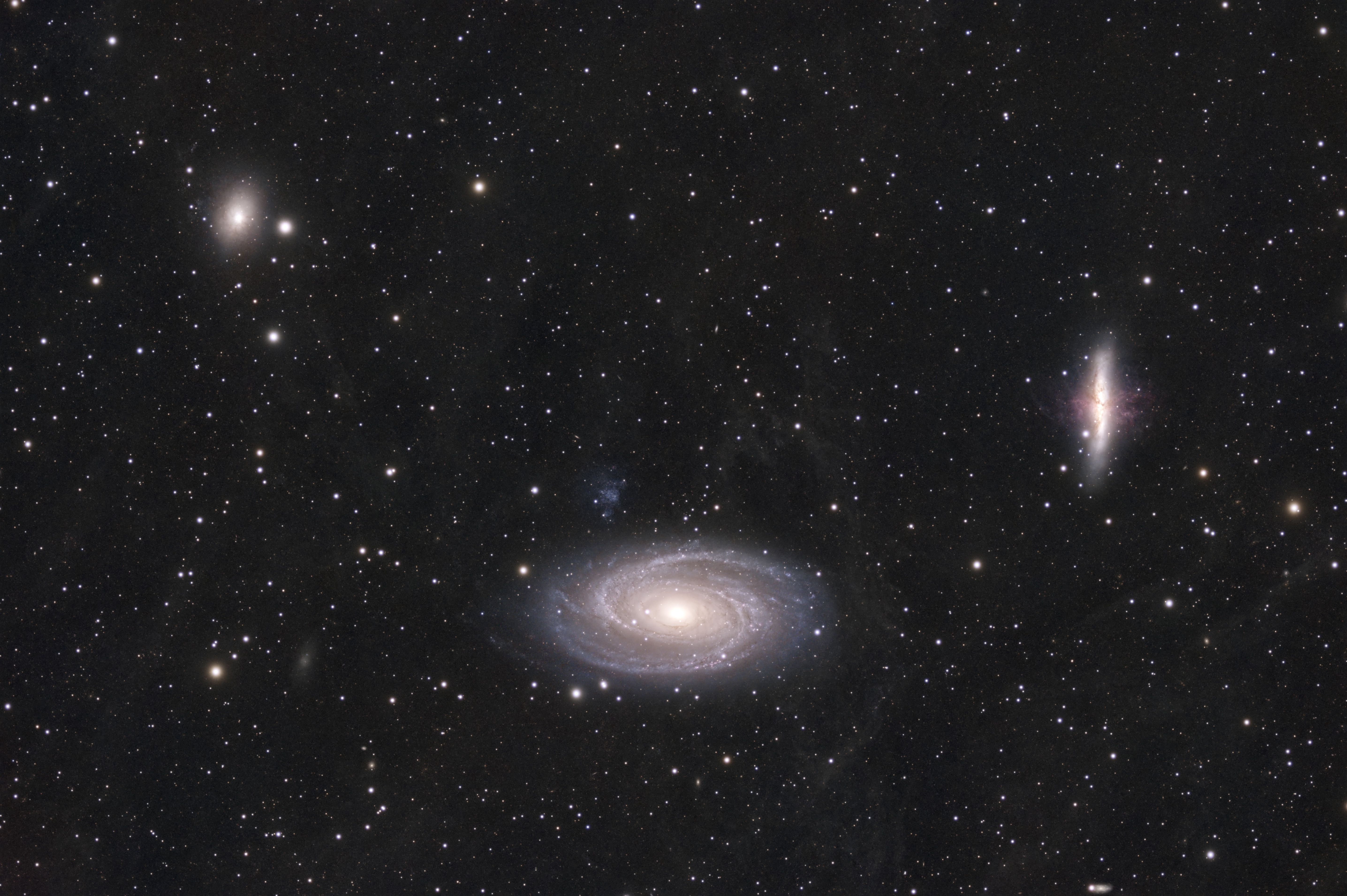
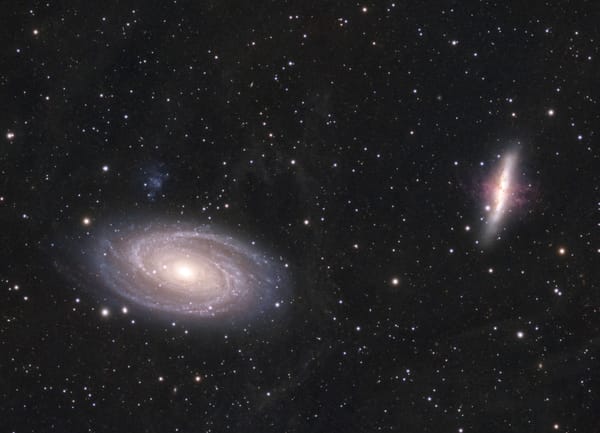
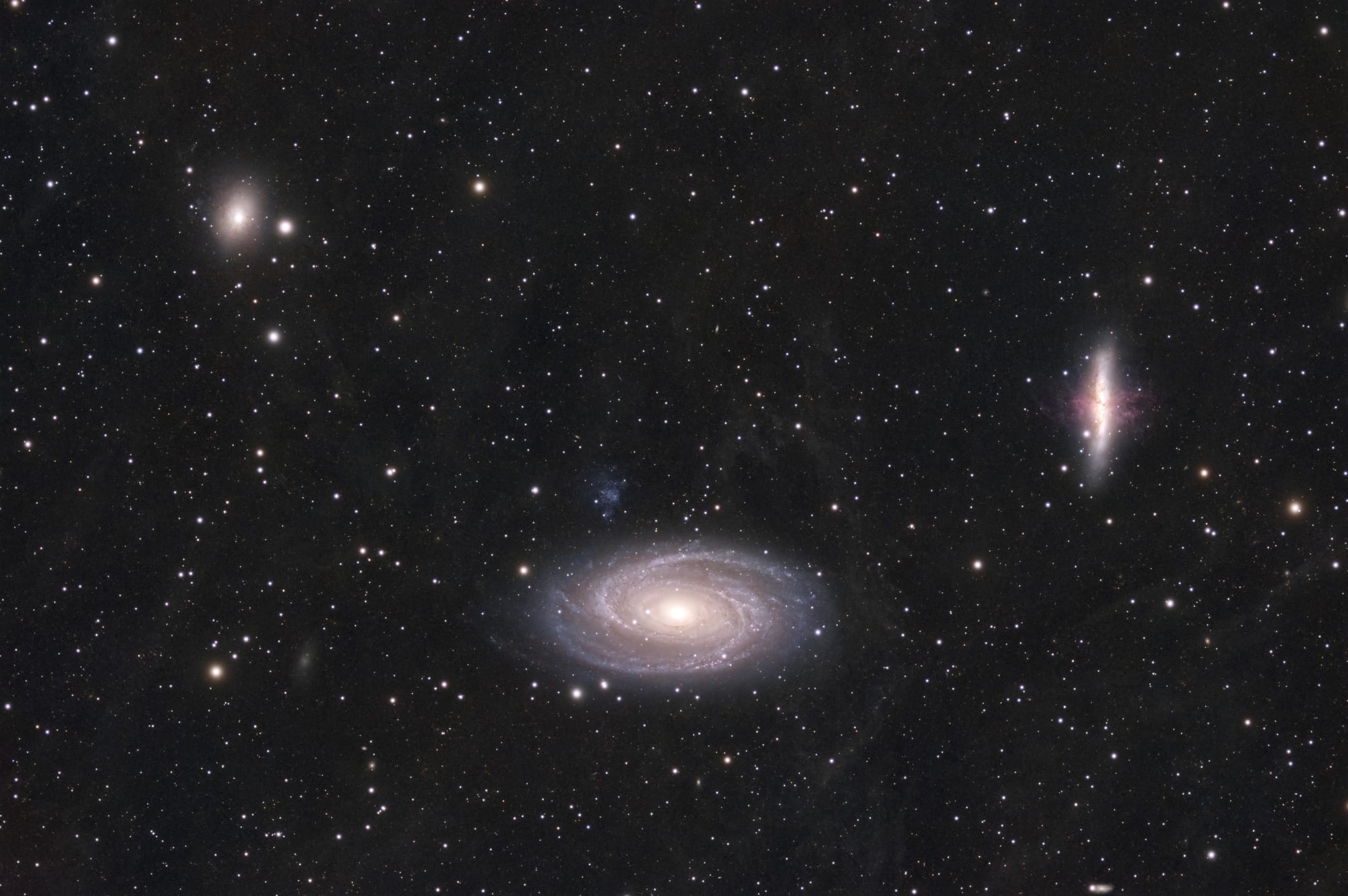
The M81 Group in Ursa Major. From left to right: NGC 3077, M81 — Bode’s Galaxy — and M82, the Cigar Galaxy.
These galaxies do not merely share the same field of view. They are gravitationally bound members of the same group and have likely passed through close encounters in the past. Those interactions disturbed the gas throughout the system, triggered bursts of star formation, and left behind extended tidal structures rich in hydrogen.
M81 is the most orderly-looking member of the trio: a grand spiral with a bright central bulge and a relatively undisturbed appearance. Yet the wider environment still bears the marks of interaction. Near M81 lies Holmberg IX, a small irregular dwarf galaxy that can easily be mistaken for a faint nebula in deep images. It is thought to be a young system, possibly formed or shaped by the tidal forces within the group.
M82 presents a striking contrast. Its disk is heavily disrupted, with dense dust lanes cutting across a bright, turbulent body shaped by intense starburst activity. From the central regions, vast outflows of hydrogen rise above and below the plane of the galaxy. This galactic superwind is powered by massive young stars, stellar winds, and the accumulated energy of supernova explosions in the core.
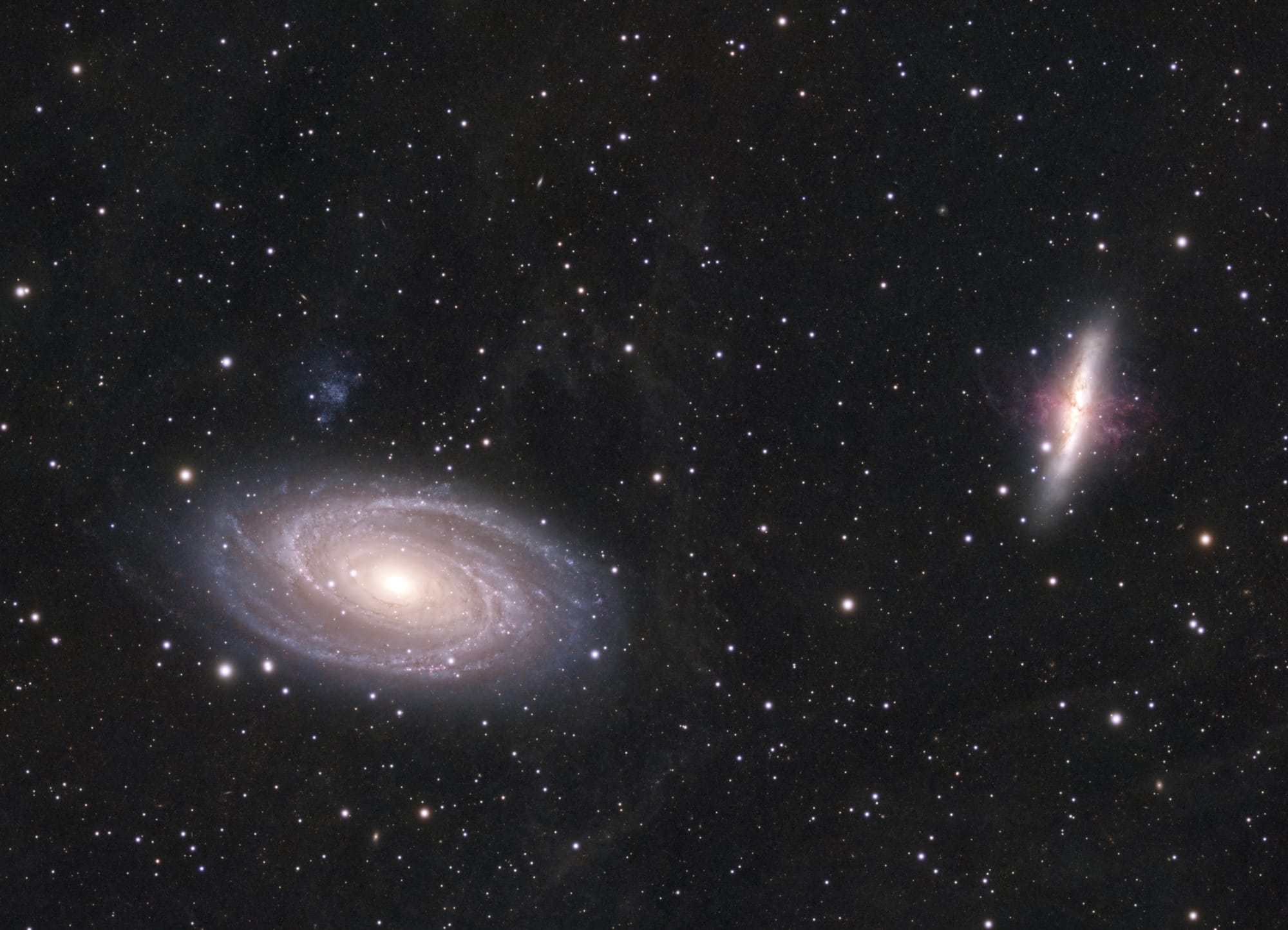
Across the wider field, faint galactic cirrus is also visible in the background. This dust is not associated with the M81 Group itself, but with our own Milky Way, lying much closer to us and adding another delicate layer of structure to the scene.
| Camera | ZWO ASI2600MC |
| Optics | Askar 103 APO |
| Mount | UMi 17S |
| Gain | 100 |
| Sensor Temperature | –10 °C |
| F-ratio | f/7 |
| Exposure | 229 × 180 s |
| Total Integration | 11.5 h |
| Processing | Siril, GraXpert, Affinity |