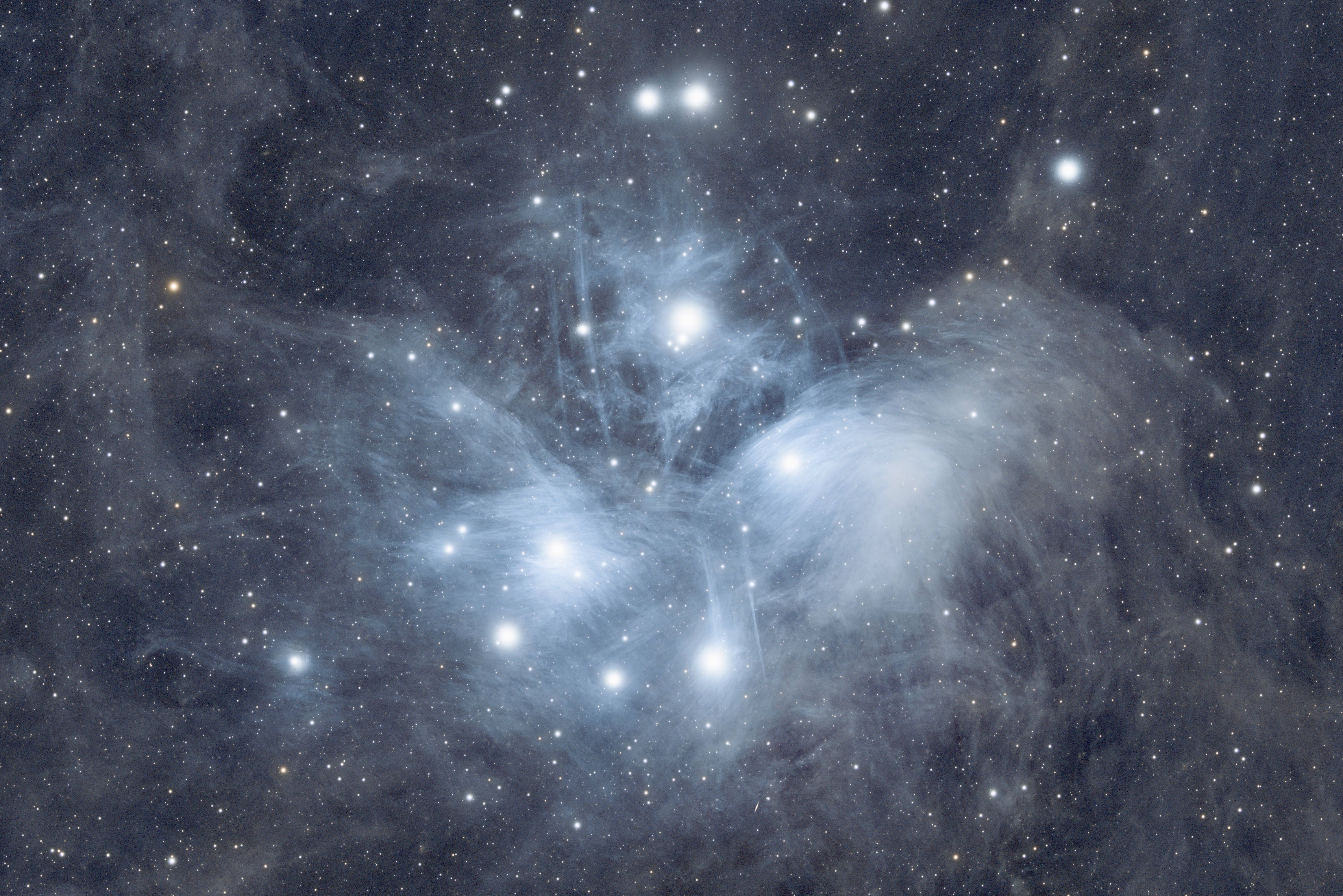
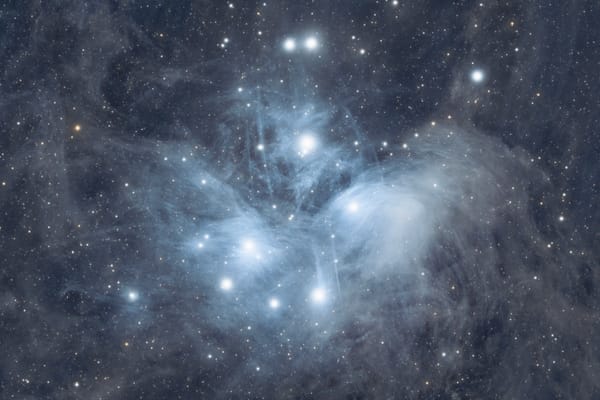
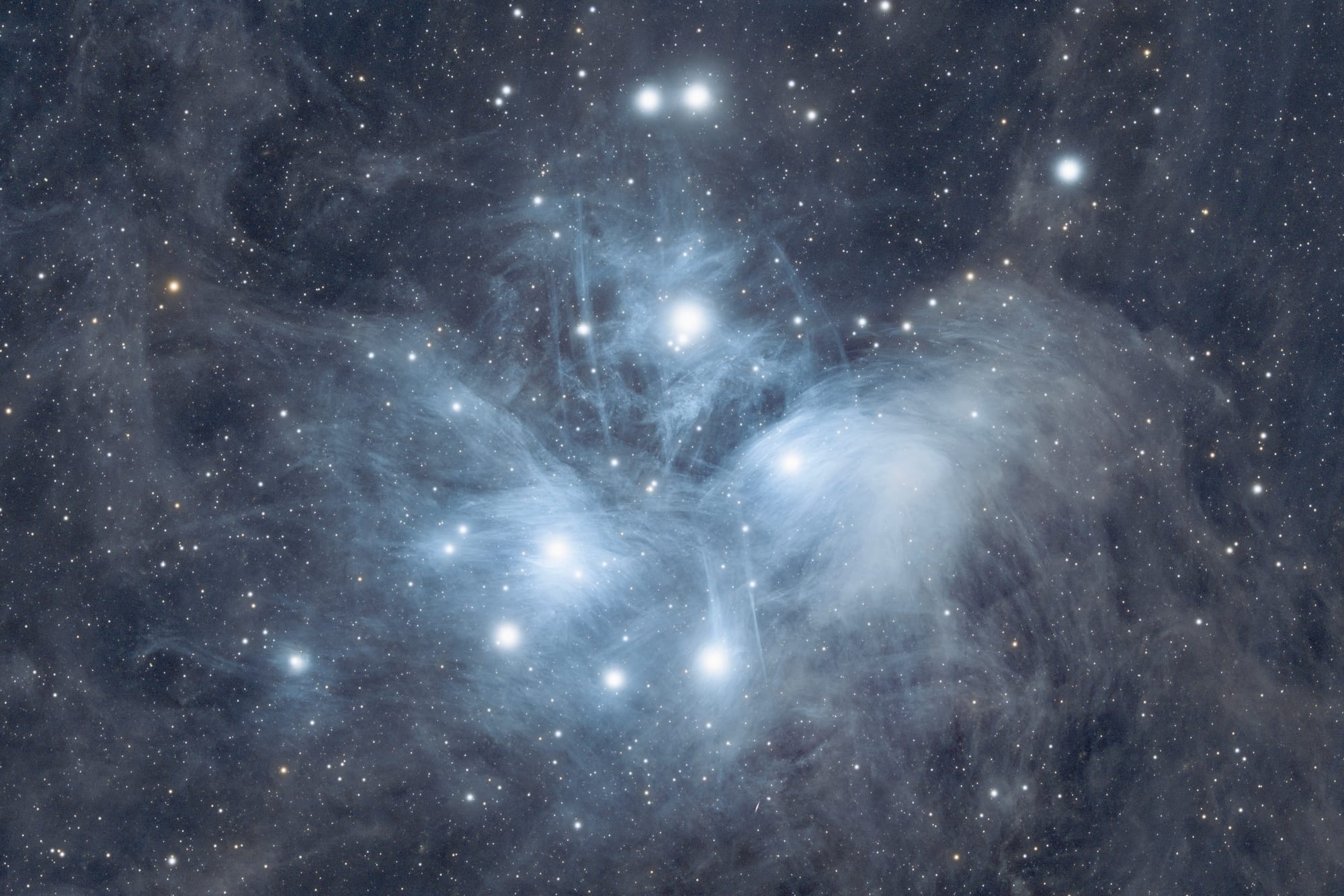
The Pleiades (M45) are one of the most beautiful open clusters in the sky, easily visible to the unaided eye. The Seven Sisters are surrounded by delicate clouds of interstellar dust that reflect their cold, blue light.
In this image, you can see not only the bright stars themselves but also the fine dust filaments enveloping the cluster. Part of this structure belongs to the so-called IFN (Integrated Flux Nebula) — an extremely faint background glow that is easily lost in noise and requires many hours of exposure to reveal.
Why does this nebula look so different from most others, with thin filaments instead of dark patches?
The clouds around the Pleiades are a mixture of dust and gas whose shapes are sculpted by the motion of the cluster and by Galactic magnetic fields. These forces act like a cosmic comb, stretching the material into long, delicate threads. As a result, we don’t see a shapeless haze but a kind of celestial fabric — fibrous, structured, and astonishingly fragile in appearance.
| Camera | ZWO ASI2600MC |
| Optics | Askar 103 APO |
| Mount | UMi 17S |
| Gain | 0 |
| Sensor Temperature | –10 °C |
| F-ratio | f/5.6 |
| Exposure | 163 × 180 s |
| Total Integration | 8.15 h |
| Processing | Siril, GraXpert, GIMP |