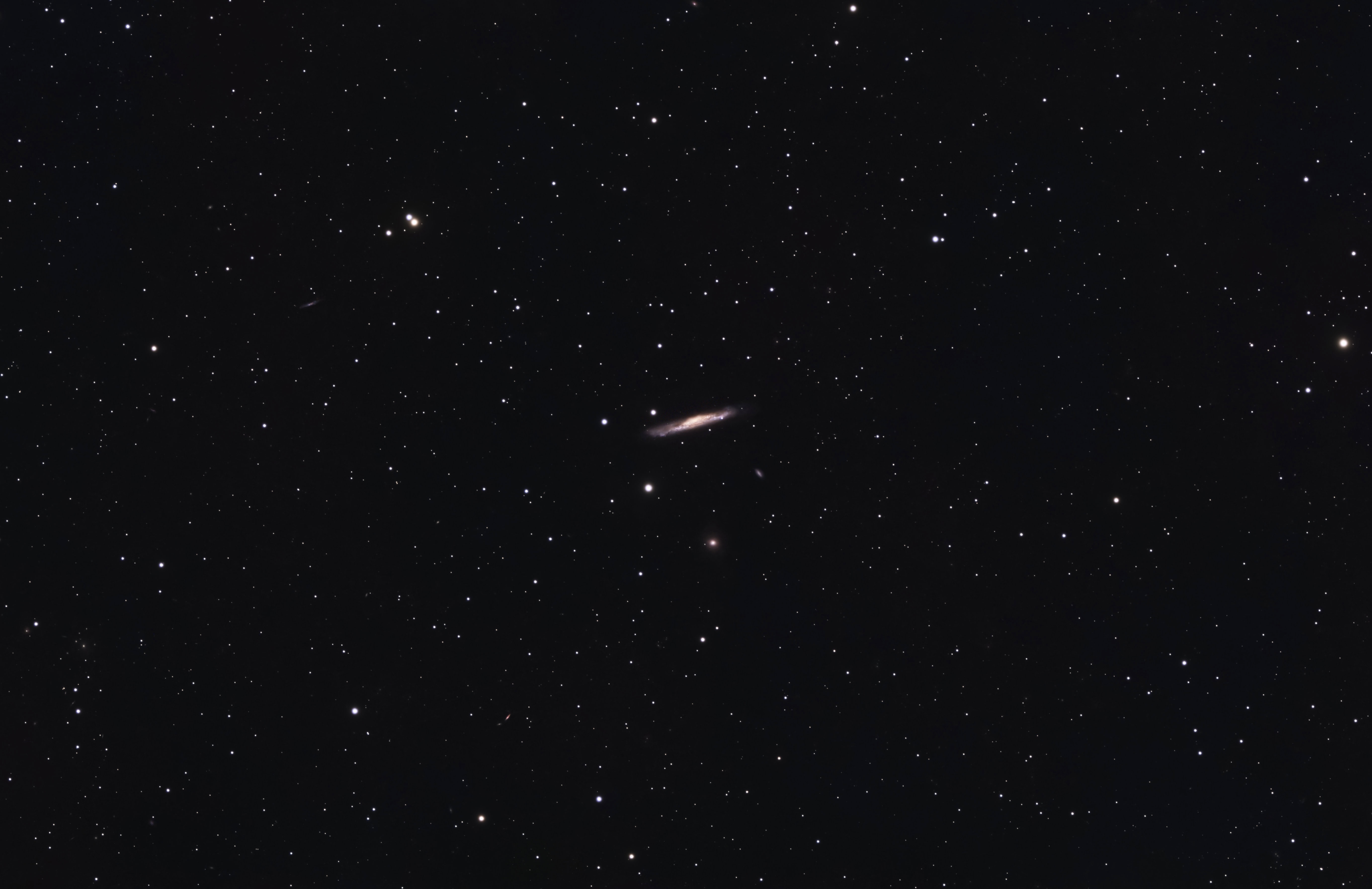
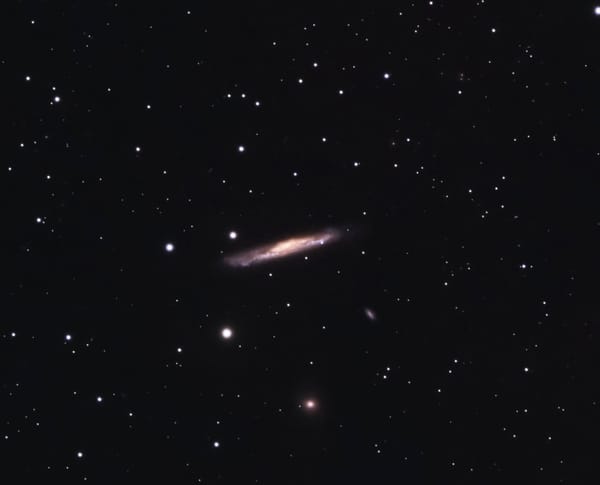
At first glance, this looks like a pretty ordinary patch of sky: the unremarkable galaxy NGC 3079, plus a sprinkle of faint background clutter. But there’s one detail here that made me spend an entire night on this shot.
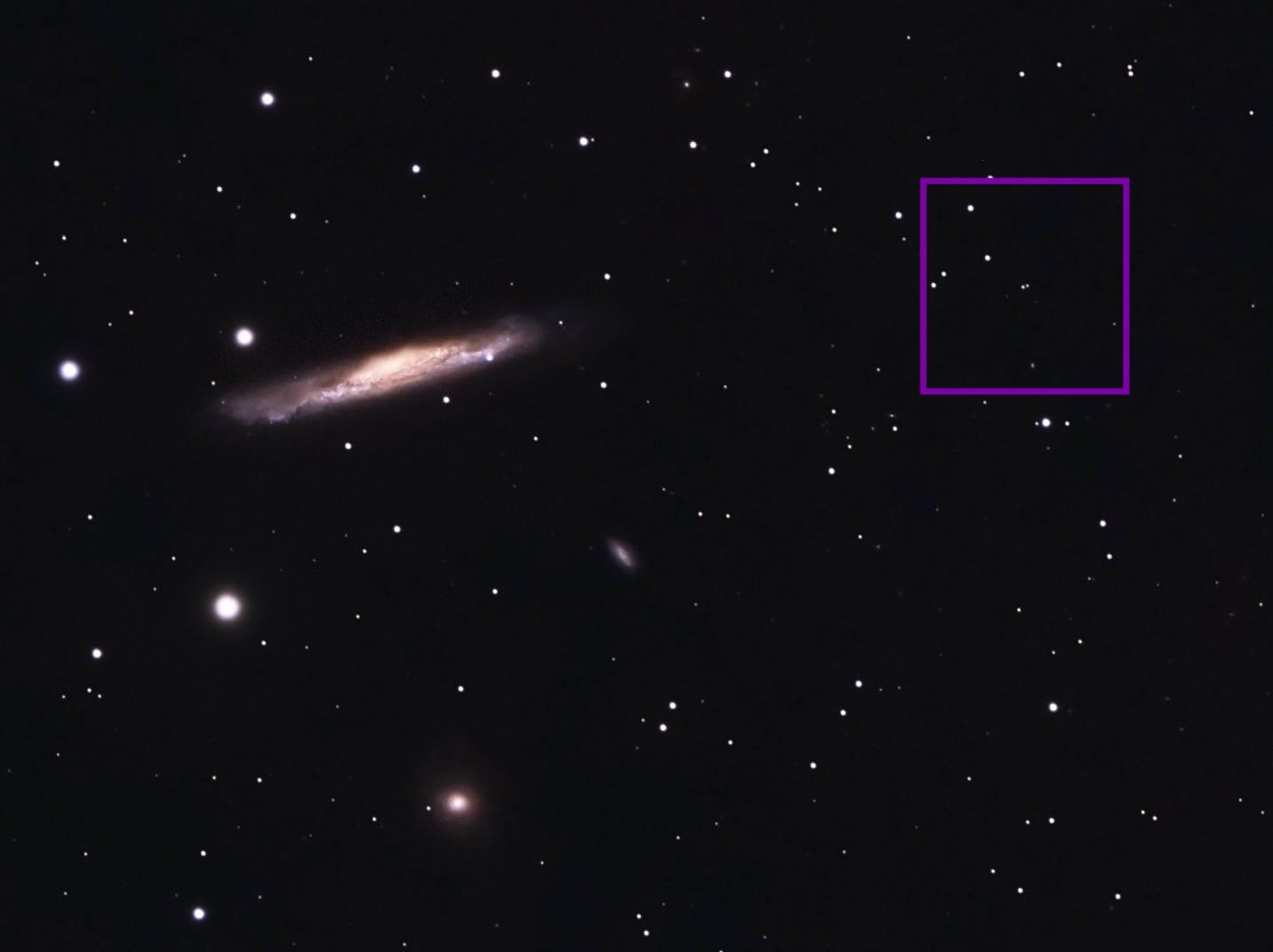
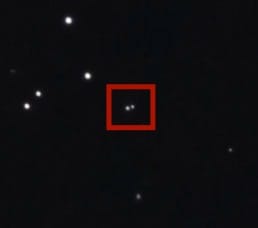
The objects inside the red frame are not stars. They are the famous quasar QSO 0957+561. A quasar is a supermassive black hole at the core of a very distant galaxy, feeding on surrounding matter. As that material spirals toward the event horizon, it accelerates to near-light speed and releases an absurd amount of energy - bright across essentially the entire electromagnetic spectrum.
The photons captured in this image have been traveling for roughly 9 billion years before hitting my sensor. For context, the Universe itself is only a little under 14 billion years old.
So why is there one quasar, but two points of light? That’s the best part: gravitational lensing. Between us and the quasar sits a massive foreground galaxy whose gravity bends spacetime - and with it, the quasar’s light. The result is two separate images of the same object reaching us along different paths.
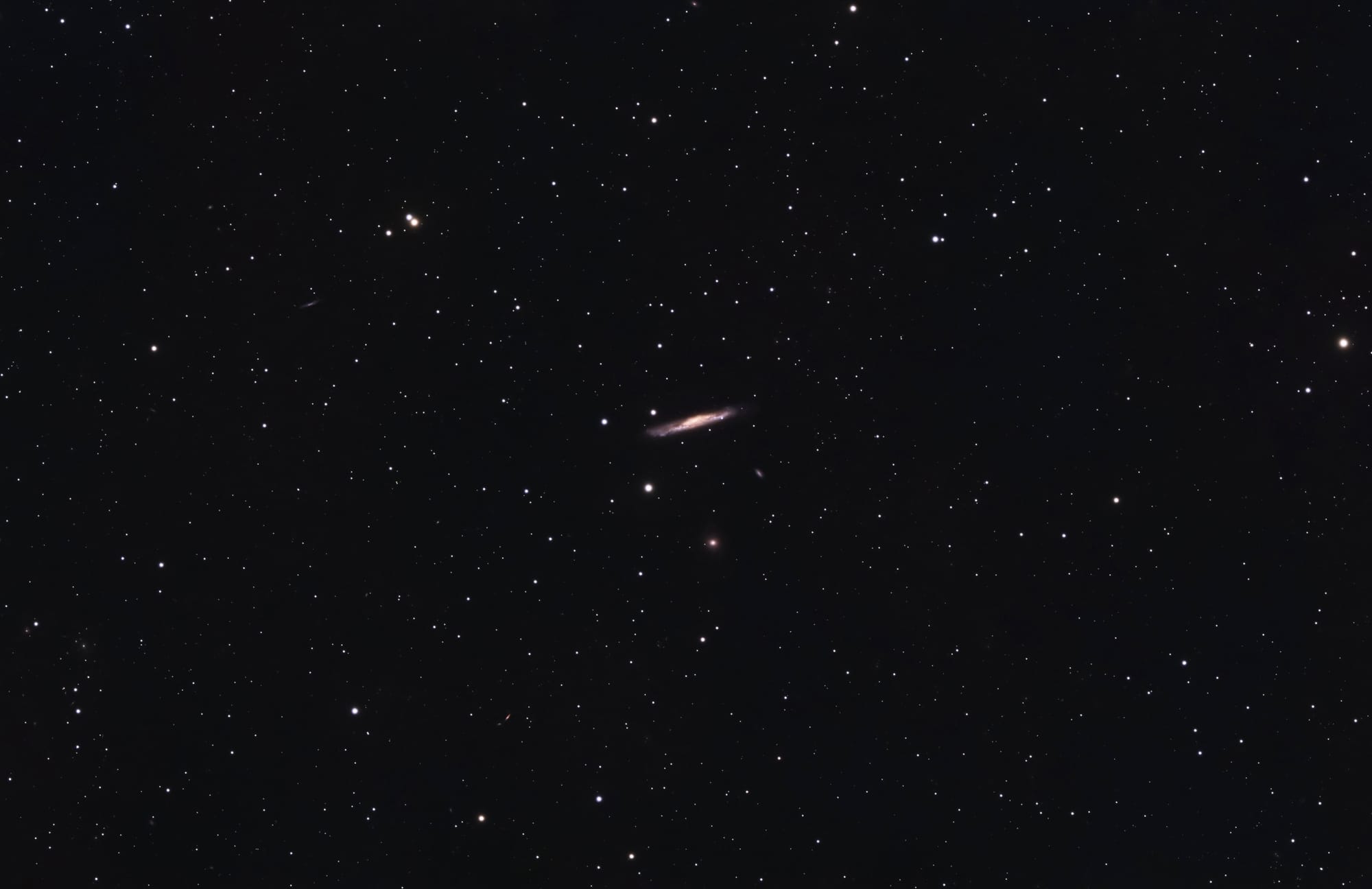
Even more surreal: this object is right at the edge of what my setup can resolve. The two images are just a couple of tiny points, barely separable - and yet the fact that you can record a gravitationally lensed quasar from the ground with amateur equipment is genuinely mind-bending. It’s a small reminder that some of the most exotic phenomena in the Universe aren’t locked behind space observatories - sometimes they’re sitting there in a “boring” field, waiting for you to notice.
| Camera | ZWO ASI2600MC |
| Optics | Askar 103 APO |
| Mount | UMi 17S |
| Gain | 100 |
| Sensor Temperature | –10 °C |
| F-ratio | f/7 |
| Exposure | 68 × 180 s |
| Total Integration | 3.4 h |
| Processing | Siril, GraXpert, Affinity |